
Wagyu beef is recognised around the world for its distinctive marbling,
rich flavour and delicate texture. It frequently appears on premium restaurant
menus and in specialist food stores, yet the term is often used without a clear
explanation of what it actually means.
Not every highly marbled steak is Wagyu, and not every Wagyu product is Kobe Beef.
The country of origin, cattle breed, genetics, grading system, certification and
production standards can all affect how a product should be described.
This guide explains the origin of Wagyu, the importance of marbling, how Japanese
beef grades are determined, what the A5 designation means and how Wagyu differs
from Kobe Beef and other premium beef products.
Quick overview: Wagyu means Japanese cattle and is associated
with four recognised Japanese breeds. Authentic Japanese Wagyu is evaluated
through a detailed grading and traceability system. A5 is a carcass grade,
while Kobe Beef is a separately protected and certified regional type of Wagyu.
What Does Wagyu Mean?
The word Wagyu is formed from two Japanese words:
wa, meaning Japanese, and gyu, meaning cattle.
The term therefore refers to Japanese cattle rather than simply any expensive
or highly marbled beef.
Official Japanese information identifies four principal Wagyu breeds:
- Japanese Black
- Japanese Brown
- Japanese Shorthorn
- Japanese Polled
Japanese Black is the most widely raised of these breeds and is strongly associated
with the intense intramuscular marbling seen in many well-known Japanese beef brands.
Regional names such as Matsusaka, Hida, Yonezawa and Kobe are generally connected
with specific production areas, bloodlines and certification requirements rather
than representing separate cattle breeds.
The word Wagyu alone does not tell the customer everything about a piece of beef.
Origin, breed, bloodline, grading, feeding, certification and traceability should
also be considered.
Where Does Wagyu Beef Come From?
Authentic Japanese Wagyu is born and raised in Japan under systems that record the
identity and movement of individual cattle. Japanese beef traceability programmes
allow authorised participants to verify information such as the animal’s origin,
breed and production history.
Wagyu genetics have also been introduced into other countries. As a result,
Wagyu-labelled beef may now come from Japan, Australia, the United States or other
producing regions.
Products outside Japan can vary considerably. Depending on the producer, the cattle
may be:
- Fullblood Wagyu
- Purebred Wagyu
- Crossbred Wagyu
- Wagyu crossed with breeds such as Angus
These products can still offer high quality, but they should not automatically be
treated as identical to certified Japanese Wagyu. Their genetics, grading systems,
feeding programmes, flavour profiles and levels of marbling may differ.
What Makes Wagyu Different?
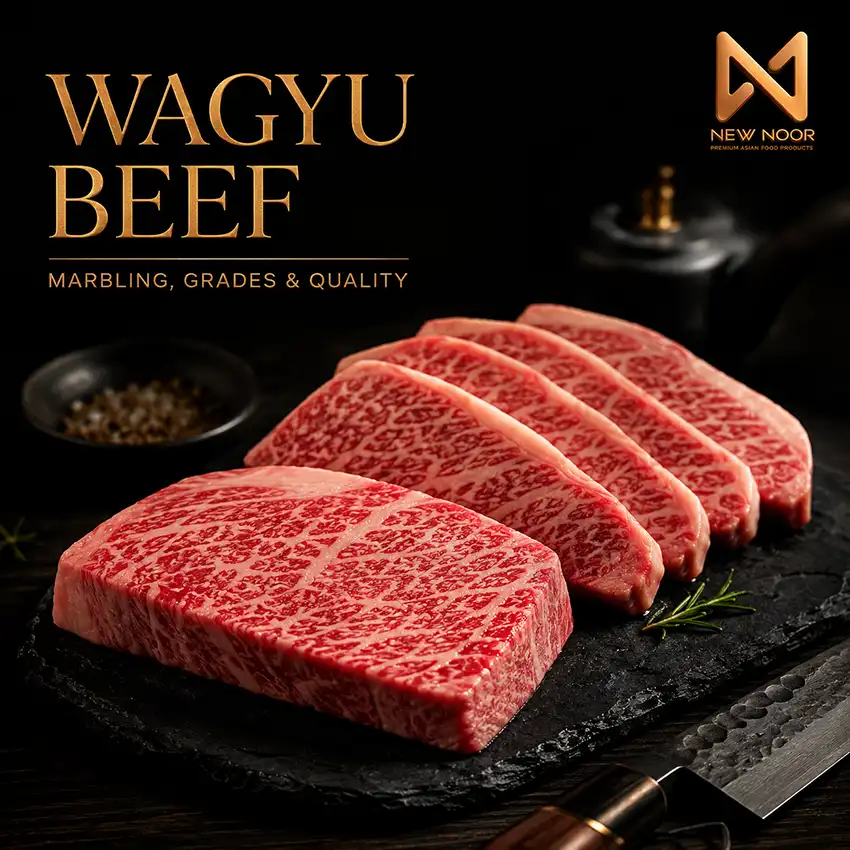
The most visually recognisable characteristic of Wagyu is its
intramuscular fat, commonly called marbling. These are the fine
white lines and small deposits of fat distributed through the muscle.
In well-marbled beef, the fat is integrated throughout the meat rather than being
present only as a thick outer layer. During cooking, some of this fat softens and
melts, influencing the beef’s:
- Juiciness
- Tenderness
- Richness
- Aroma
- Mouthfeel
High-quality Wagyu is not evaluated by marbling alone. Meat colour, brightness,
firmness, texture and the quality and appearance of the fat are also considered
within the Japanese grading system.
Understanding Marbling
Marbling refers to fat located within the muscle tissue. It should not be confused
with large external pieces of fat around the edge of a steak.
Fine, evenly distributed marbling is particularly valued because it can create a
more consistent texture throughout the cut. In premium Wagyu, the lean and fat can
appear closely interwoven, producing a pattern that is noticeably different from
many conventional steaks.
Does More Marbling Always Mean Better Beef?
More marbling usually contributes to greater richness and is an important part of
Japanese quality grading. However, the most heavily marbled option is not necessarily
the preferred choice for every person or every dish.
A very highly marbled steak can be extremely rich. Some diners may prefer a lower
marbling level with a stronger traditional beef flavour, particularly when serving
a larger steak.
The ideal level therefore depends on:
- The cut of beef
- The cooking method
- The portion size
- The menu concept
- The desired balance between richness and beef flavour
How Is Japanese Wagyu Graded?
Japanese beef carcass grading combines two separate evaluations:
- Yield grade
- Meat quality grade
These two results are shown together in grades such as A4, A5, B4 or B5.
Yield Grade: A, B or C
The letter estimates how much usable meat can be obtained from the carcass.
It is not a direct measurement of flavour or tenderness.
| Yield Grade | General Meaning |
|---|---|
| A | Above-standard yield of usable meat |
| B | Standard yield of usable meat |
| C | Below-standard yield of usable meat |
Quality Grade: 1 to 5
The number represents meat quality, with 5 being the highest level in the Japanese
grading structure.
The quality evaluation considers four main factors:
- Marbling
- Meat colour and brightness
- Firmness and texture
- Fat colour, lustre and quality
The final quality grade is not based only on the most impressive characteristic.
The carcass must perform consistently across the required quality factors.
What Does A5 Wagyu Mean?
An A5 grade combines:
- A: the highest yield classification
- 5: the highest meat quality classification
A5 is therefore the highest possible combination within the Japanese carcass
grading system.
It is important to understand what this grade does and does not mean.
A5 indicates that the carcass met strict measurable standards for yield and meat
quality. It does not identify a specific regional brand, farm or cattle bloodline,
and it does not automatically mean the product is Kobe Beef.
Two A5 cuts can also offer different dining experiences because of differences in:
- Breed and bloodline
- Region of production
- Marbling distribution
- Cut of beef
- Ageing method
- Thickness and preparation
What Is the Beef Marbling Standard?
The Beef Marbling Standard, commonly abbreviated as BMS, is used
to assess the level of marbling in Japanese beef.
The scale runs from 1 to 12. Higher numbers represent more extensive marbling.
The BMS result contributes to the quality grade, but marbling is not the only
factor considered.
| Japanese Quality Grade | Typical BMS Range |
|---|---|
| Grade 1 | BMS 1 |
| Grade 2 | BMS 2 |
| Grade 3 | BMS 3–4 |
| Grade 4 | BMS 5–7 |
| Grade 5 | BMS 8–12 |
A high BMS score can help a carcass qualify for a higher quality grade, but the
other quality factors must also meet the required level.
Wagyu and Kobe Beef: What Is the Difference?
Wagyu and Kobe Beef are related terms, but they are not interchangeable.
Wagyu is the broader category of recognised Japanese cattle.
Kobe Beef is a certified regional type of Wagyu that must satisfy
strict conditions established by the Kobe Beef Marketing and Distribution
Promotion Association.
Certified Kobe Beef must come from eligible Tajima cattle connected with Hyogo
Prefecture and must meet requirements involving:
- Approved Tajima bloodline
- Birth and raising within Hyogo Prefecture
- Processing at an approved facility in Hyogo
- Eligible heifer or steer
- Yield grade A or B
- Quality grade 4 or higher
- BMS level 6 or higher
- Specified carcass-weight limits
- Official inspection and certification
This means that all certified Kobe Beef is Wagyu, but only a small and carefully
controlled portion of Wagyu qualifies as Kobe Beef.
A menu description using the word “Kobe” should be supported by official
certification. High marbling or premium pricing alone does not make beef
authentic Kobe Beef.
Japanese, Australian and American Wagyu
Wagyu-labelled beef is produced in several countries, but the products should be
compared carefully because the terminology and grading systems are not identical.
Japanese Wagyu
Japanese Wagyu is produced in Japan and is commonly supported by detailed
traceability documentation. It may carry a Japanese carcass grade such as A4 or A5,
along with information about origin, individual cattle identification and regional
branding.
Australian Wagyu
Australian producers raise both fullblood and crossbred Wagyu cattle. Australian
grading and marbling systems differ from the Japanese A-to-C and 1-to-5 structure,
so the numbers should not be compared directly without understanding the relevant
standard.
American Wagyu
American Wagyu may include fullblood cattle, purebred cattle or crossbred animals.
A common approach is to combine Wagyu genetics with Angus genetics to create a
balance between marbling and a stronger traditional beef flavour.
The country name alone does not determine quality. Buyers should examine the
producer, genetic description, marbling information, grading standard,
traceability and intended use.
What Does Wagyu Taste Like?
The experience depends on the cut, marbling level, origin and preparation.
Highly marbled Japanese Wagyu is often described as:
- Rich
- Juicy
- Delicate
- Buttery in mouthfeel
- Soft in texture
- Intensely savoury
Because the fat is distributed through the muscle, highly marbled Wagyu can feel
different from a conventional steak with a thick outer fat layer.
The richness also means that it is often served in smaller portions. Rather than
presenting one very large steak, restaurants may serve several carefully sliced
pieces as part of a tasting-style experience.
How to Choose Quality Wagyu Beef
The word Wagyu should not be the only information used when selecting a product.
Restaurants, retailers and consumers should review the full product description.
1. Check the Country of Origin
Confirm whether the beef comes from Japan, Australia, the United States or another
country. The origin affects the grading system and the meaning of the product claim.
2. Review the Breed or Genetic Description
Look for terms such as fullblood, purebred or crossbred. These terms should be
supported by clear producer information.
3. Check the Grading System
An A5 grade applies to the Japanese grading system. A marbling score from another
country should not automatically be treated as equivalent.
4. Request Traceability Information
Authentic Japanese Wagyu is commonly accompanied by documentation such as:
- Individual cattle identification number
- Certificate of authenticity
- Country and prefecture of origin
- Carcass grade
- Processing information
5. Examine the Marbling Distribution
Good marbling should appear fine and well distributed rather than being limited to
a few large deposits of fat.
6. Choose the Right Cut
Ribeye, striploin and tenderloin offer different combinations of tenderness,
marbling and flavour. Less familiar cuts can also provide a strong Wagyu experience
when prepared correctly.
7. Match the Product to the Menu
The most expensive grade is not required for every application. A restaurant may
choose different Wagyu specifications for:
- Steaks
- Yakiniku
- Shabu-shabu
- Sukiyaki
- Burgers
- Small tasting portions
- Premium sandwiches
How Should Wagyu Be Cooked?
Wagyu should be cooked in a way that respects its fat content and delicate texture.
Highly marbled cuts usually require less added fat than conventional steaks.
Use Controlled Heat
A heavy pan, cast-iron surface or flat grill provides direct contact and helps
develop an even exterior.
Very thin cuts can be cooked quickly over high heat. Thicker cuts may benefit from
a more controlled combination of searing and gentler heat.
Keep Seasoning Simple
Salt is often enough to highlight the natural flavour. Strong marinades or heavy
sauces can conceal the qualities that make premium Wagyu distinctive.
Use Smaller Portions
The richness of highly marbled Wagyu means that a smaller serving can provide a
complete experience. Thin slices also allow the fat and lean meat to be enjoyed
together.
Do Not Overcrowd the Pan
Cooking too many pieces at once lowers the surface temperature and can prevent
proper browning.
Allow the Meat to Rest
A brief resting period can help the meat settle before slicing and serving.
Food safety requirements must still be followed. Use a food thermometer and comply
with local guidance. The United States Department of Agriculture recommends that
whole beef steaks, chops and roasts reach at least 63°C or 145°F, followed by a
three-minute resting period.
Storage and Handling
Premium pricing does not remove the need for careful food handling.
- Keep chilled Wagyu refrigerated according to the supplier’s instructions.
- Maintain the cold chain during transport and receiving.
- Check use-by dates and packaging integrity.
- Thaw frozen beef in controlled refrigeration rather than at room temperature.
- Keep raw beef separate from ready-to-eat foods.
- Use clean utensils and preparation surfaces.
- Follow local food-safety rules for cooking and storage.
For restaurants and distributors, temperature records, batch information and
supplier documentation should form part of the receiving process.
Common Misunderstandings About Wagyu
“All Wagyu Comes from Japan”
Wagyu genetics are now used in several countries. The label should state the
actual country of origin and provide sufficient information about breed and grading.
“All Wagyu Is A5”
A5 is a specific Japanese carcass grade. Wagyu exists across different quality,
yield and marbling levels.
“Wagyu and Kobe Are the Same”
Kobe Beef is one strictly certified regional type of Wagyu. Most Wagyu is not
Kobe Beef.
“More Fat Automatically Means Higher Quality”
Marbling is important, but Japanese quality grading also evaluates colour,
brightness, firmness, texture and fat quality.
“A5 Is Always the Best Choice for Every Dish”
A5 represents the highest grading combination, but its intense richness may not
suit every recipe, portion size or customer preference.
“Wagyu Must Be Served as a Large Steak”
Highly marbled Wagyu is often more effective in smaller portions, thin slices or
tasting menus.
Frequently Asked Questions
Is Wagyu a Breed or a Brand?
Wagyu is a collective term associated with recognised Japanese cattle breeds.
Regional names such as Kobe are separate certified brands with additional rules.
What Is the Highest Japanese Wagyu Grade?
A5 is the highest combination in the Japanese carcass grading system, combining
yield grade A with quality grade 5.
Is Every A5 Wagyu Product Kobe Beef?
No. A5 describes carcass yield and quality. Kobe Beef must also meet regional,
bloodline, production, processing and certification requirements.
Can Wagyu Be Produced Outside Japan?
Wagyu cattle and Wagyu-cross cattle are raised outside Japan. However, products
from different countries can use different genetics, grading systems and production
methods.
Why Is Wagyu Usually Served in Small Portions?
Highly marbled Wagyu is exceptionally rich. Smaller portions allow the flavour
and texture to be appreciated without overwhelming the meal.
How Can Authentic Japanese Wagyu Be Verified?
Check the country of origin, individual identification number, certificate,
carcass grade, supplier details and traceability documentation.
Does Darker Red Meat Mean Higher Quality?
Colour alone does not determine Wagyu quality. Marbling, texture, firmness,
fat quality, cut, freshness and official grading must be considered together.
Final Thoughts
Wagyu is not simply another name for expensive beef. It represents recognised
cattle genetics, specialised production systems and, in the case of Japanese Wagyu,
a detailed structure of grading and traceability.
Understanding the difference between Wagyu, Japanese Wagyu, A5 Wagyu and Kobe Beef
helps buyers evaluate products more accurately and avoid relying on unclear menu
descriptions or marketing claims.
For restaurants, retailers and distributors, the most suitable Wagyu product is
the one that matches the menu, serving style, customer expectations, required
marbling level and target price.
New Noor is expanding its educational resources around premium and specialty food
products. The objective is to help food businesses understand origin, quality,
grading and product selection before making sourcing decisions.
References
Ministry of Agriculture, Forestry and Fisheries of Japan — Overview of Wagyu Breeds
Japan Livestock Products Export Promotion Council — Universal Wagyu Mark and Breeds
Japan Meat Grading Association — Beef Carcass Grading Standard
Kobe Beef Marketing and Distribution Promotion Association — Official Definition of Kobe Beef
USDA Food Safety and Inspection Service — Safe Minimum Internal Temperature